Tiradito de Vieiras
Fire-seared scallop, ice-cold apple, Nikkei tiger's milk
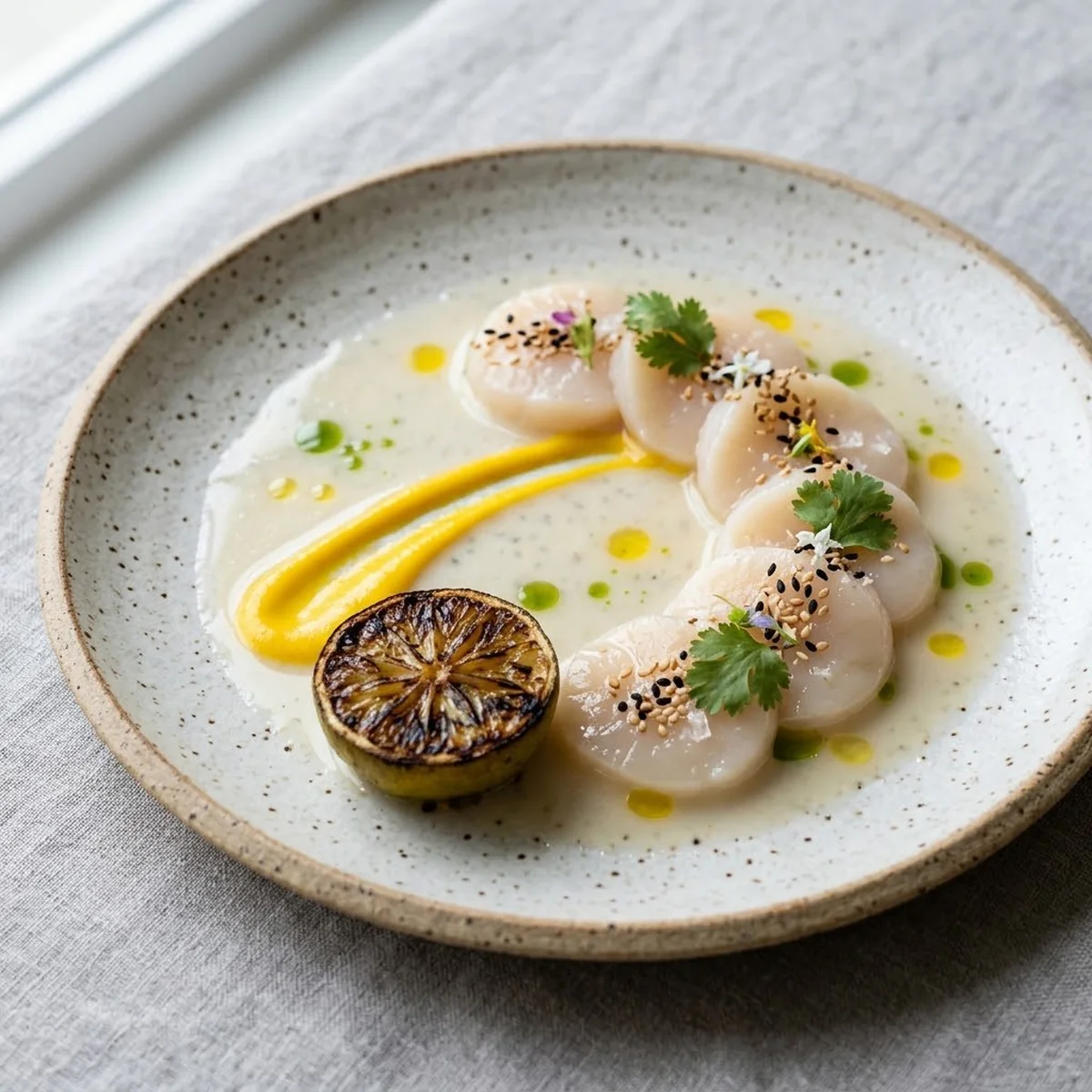
The scallop arrives at the table still crackling from the pan. The apple goes on top ice-cold, straight from the freezer cure. If the scallop is hot enough, you hear it. That sound is the dish.
01 · Flavor architecture
02 · Time breakdown
Stage detail
| Stage | Clock time | Active? | Note |
|---|---|---|---|
| Apple brunoise + cure assembly | 10 min | Yes | |
| Apple cold cure in freezer | 10 min | No | Prep scallops during this window |
| Scallop prep + seasoning | 5 min | Yes | Pat dry twice — structural requirement |
| Sear | 3–4 min | Yes | Eyes on pan only |
| Dress + plate | 3 min | Yes | 90-second window after apple hits scallop |
| Total active | 22 min | ||
| Total clock | 35 min |
03 · Ingredients
- Juice of 3 limes (hand-squeezed, light pressure — hard squeezing releases bitter pith compounds)
- ají amarillo paste (jarred is correct here — this is not a shortcut)1 tbsp
- fresh ginger, microplaned1 tsp
- soy sauce (light soy — glutamate without color)1 tbsp
- ½ tsp honey (rounds the ají heat; bridges to the scallop's natural sweetness)
- bird's eye chili: half brunoise for the cure, half paper-thin rounds reserved for garnish1
- ½ Granny Smith apple, 4mm brunoise (cut last, immediately into the cure)
- sesame oil (added at the end, not during cure — blunts acidity if it sits)1 tsp
- large scallops, roe off6–8
- Fleur de sel + freshly cracked white pepper
- unsalted butter30g
- white sesame, toasted1 tsp
- Flat-leaf coriander — a few leaves only
- extra squeeze of lime at plating1
04 · Technique
Build the cure
Combine lime juice, ají amarillo, ginger, soy, honey, and brunoise chili. Whisk. Taste it now: sour-hot-salty, with just enough sweetness underneath that it doesn't flinch. This is not a dressed salad — it is an aggressive acid bath. Add the apple brunoise. Stir to coat. Cover and place in the freezer. Timer: 10 minutes exactly. Víctor Moreno is unambiguous: 10 minutes, no more. The apple should emerge cold, still with full crunch.
Hold the sesame oil until the end.
Prepare the scallops
Pat dry with paper towel. Press firmly. Do it again. Any surface moisture = steam in the pan = no crust. Season the flat faces only (top and bottom) with fleur de sel and white pepper. Leave the sides alone.
If you have 30 extra minutes: set scallops uncovered on a rack in the fridge. The surface dries further. The crust will be better.
Sear
Light-coloured pan — you need to see the butter's color. Medium-high heat, pan first, then butter. Watch it foam. Watch the foam thin. The moment it smells of roasted hazelnuts and turns amber: scallops in, flat face down. Do not move them.
90 seconds. One gentle press per scallop if they curl — they are contracting away from you. After 90 seconds, check one edge: mahogany. Flip all at once. 45–60 seconds on the second face. Remove to a warm plate. Carryover will finish the center.
Opaque at the edges, translucent at the heart. Opaque all the way through means ten seconds past.
Dress
Pull the apple from the freezer. Add the sesame oil. Toss. Taste: does it still have aggression? If the ají has mellowed, a pinch more salt and a further squeeze of lime reactivates it. The apple must be ice-cold to the touch.
Plate immediately.
05 · Why it works
2 principles
The scallop's TMAO compounds (source of oceanic sharpness) are suppressed by acid.
Malic acid from the apple and citric acid from the lime work at the same pH but with different aromatic profiles: the apple adds a fruit-sweet layer to the suppression that lime alone doesn't deliver. The temperature differential is neurological: cold and hot activating different thermoreceptors simultaneously makes the flavors read as more distinct and more intense than they would at a uniform temperature. This is why the apple must be ice-cold when it touches the hot scallop, not merely chilled. The soy amplifies the scallop's own umami rather than adding a competing note. The ají amarillo provides tropical-floral heat that rises without obscuring the scallop's sweetness; the bird's eye delivers the front-palate burn.
The Nikkei satellite (soy + sesame + lime alongside ají) is documented in Moreno's tiradito de atún: lime + naranja concentrada + soya light + aceite de sésamo + jengibre.
Verified lineage, not approximation.
06 · Texture map
07 · Plating
Spoon a thin diagonal stripe of the leche de tigre liquid (liquid only) off-center across the plate. Three scallops placed loosely on that line — not a row, not a triangle, just arrived there. They should look unplaced.
Stack the apple brunoise directly on top of each scallop — uneven, generous. The apple should sit proud, visibly cold and white against the mahogany crust below. The temperature contrast is the architecture; it must be readable before the first bite.
Sesame scattered across the apple. Three or four chili rounds at angles — not symmetrically. Coriander last: a few leaves tucked at the edge of the apple pile, not broadcast across everything.
No sauce pooled. The leche de tigre stripe is sufficient.
08 · The moment
This is a Collision. Do not dress the scallops in the kitchen. Bring the seared scallops to the table bare — glossy, caramelized, still faintly steaming. Set the bowl of apple cure beside them. Then spoon the apple on top tableside, in full view. If the scallop is hot enough, the apple hisses faintly when it lands. That sound is the dish announcing the temperature differential before the first bite confirms it. You have 90 seconds before the thermal collision resolves and the apple warms. Eat from the moment of contact. Do not explain the dish. The first bite is the explanation.
09 · Chef's notes
If something goes wrong
Scallop sticks — the pan was not hot enough or the surface was not dry enough. Do not force it. Wait 15 more seconds: a properly seared scallop releases itself. If it tears, plate crust-side up; the apple covers the damage.
Leche de tigre too aggressive — add ¼ tsp more honey and a pinch of salt. Sweetness and sodium lower acid perception significantly without diluting flavor.
Apple gone soft — either cut too thin (4mm is the floor) or left in the cure past 10 minutes. Thicker dice next time; hold the timer.
Substitutions
- Ají amarillo paste → ½ tsp yellow chili sauce + ½ tsp turmeric: loses the tropical-floral character, gains earthier heat. Add a pinch of cumin to compensate.
- Granny Smith → Pear: sweeter and musky, the sharp malic acid drops. Increase lime by half a lime to restore the acid structure; the dish becomes softer in character.
- Beurre noisette → Olive oil: the hazelnut-Maillard mirror between the nut and the crust disappears. Add a small cold knob of butter to the pan in the last 20 seconds to recover some aromatic complexity.
Scaling
For 4: double all quantities. Sear in two batches — never crowd the pan. The second batch is 10–15 seconds faster because the pan is fully calibrated. Keep the first batch warm under foil.
Vegetarian counterpart
King oyster mushrooms, halved lengthwise, scored on the cut face. Identical beurre noisette sear — 3 minutes per side to mahogany. The soy in the apple cure mirrors the soy glaze logic natural to the mushroom. Works without any other modification. The earthy umami of the king oyster replaces the oceanic sweetness of the scallop with a different but equally valid base note.
10 · Drink pairing
Grüner Veltliner (Wachau, Federspiel or Smaragd)
the white pepper note harmonizes with the bird's eye heat and ají amarillo's tropical register while its high natural acidity mirrors the leche de tigre without fighting it. Alternative: Txakoli — the spritz and salinity are built for hot shellfish, and the body won't overpower the cure.
Agua de pepino y limón, lightly salted
cucumber's cool vegetal note resets the palate between bites without introducing sweetness that would soften the ají.
11 · Sources
- Cure technique: Víctor Moreno, Cebiche Sebiche Ceviches — 10-minute cold cure, hand-squeezed light-pressure lime, ají amarillo paste, verified Peruvian-trained lineage
- Nikkei satellite (soy + sesame + lime): Moreno's tiradito de atún construction: limón + naranja concentrada + soya light + aceite de sésamo + jengibre
- Scallop + apple pairing (TMAO + temperature contrast): `_databases/flavor-pairs-condiments-proteins-fruits.md` — confirmed by The Whole Fish Cookbook and Flavor Thesaurus
- Temperature contrast plating: the chef's signature technique — `chef-identity.md`
- Tableside apple dressing (Collision moment): the chef's composition decision — not from any single source