Raviolo al Uovo
One yolk, one raviolo, one moment that cannot be undone
Read this recipe twice before you start. The pasta is forgiving. The filling is forgiving. The cooking time is not. The difference between 2 minutes 30 seconds and 3 minutes 30 seconds is the difference between a yolk that flows and a yolk that has set. You cannot see through the pasta. You are working on faith and timing. When the knife goes in at the table, the dish finishes itself.
01 · Flavor architecture
02 · Time breakdown
Stage detail
| Stage | Clock time | Active? | Note |
|---|---|---|---|
| Make pasta dough | 12 min | Yes | |
| Rest dough | 30 min | No | Make béchamel and chill filling during this time |
| Make and chill béchamel dam | 15 min | Yes + No | Make in 5 min; needs 10 min to firm in fridge |
| Construct ravioli | 15 min | Yes | This is the chirurgie — no rushing |
| Cook ravioli + beurre noisette | 8 min | Yes | Parallel operations — requires full attention |
| Total active | ~45 min | ||
| Total clock | ~75 min |
03 · Ingredients
- 00 flour (or plain flour — see note; 00 gives a silkier skin that is easier to seal without trapping air)100g
- large egg1
- yolk (the extra yolk adds richness and colour)1 egg
- ½ tsp olive oil
- Pinch of fine salt
- unsalted butter15g
- plain flour15g
- whole milk (add gradually — you want the final béchamel very thick, firmer than ragù, closer to a stiff paste)100–120ml
- Grating of fresh nutmeg
- Salt and white pepper
- fresh egg yolks — the freshest you can find (old egg yolks break when you pick them up; fresh yolks are cohesive, resistant, hold their shape)2
- unsalted butter60g
- walnuts, finely chopped40g
- Optional: a few drops of chili oil for the chef's version
- Flaky salt
- Coarsely ground black pepper
- Optional: 20g Parmigiano, finely grated (not for wife-inclusive serving — see note)
04 · Technique
Pasta dough
Same method as the pappardelle. Mound flour, make well, add egg, yolk, oil, and salt. Beat eggs with fork, incorporate flour gradually. Knead 10 minutes until satiny and elastic. The dough for raviolo should be slightly softer than pappardelle dough — add a few drops of water if it feels stiff. Wrap in cling film. Rest 30 minutes.
The béchamel dam
Melt butter in a small saucepan over medium heat. Add flour and stir constantly for 90 seconds — this cooks out the raw flour taste. Add milk in three small additions, whisking between each addition until completely smooth before adding more. The final béchamel must be very thick — it should hold a groove when you drag a spatula through it. Season with nutmeg, salt, and white pepper. Transfer to a piping bag or a small ziplock bag (cut a 1cm hole in one corner). Refrigerate until completely cold and firm — minimum 10 minutes. A warm béchamel will run under the yolk rather than containing it.
Construction (this is the chirurgie)
Roll the pasta dough as thin as possible — you must be able to see your hand through it when held to the light. Cut four pieces: two bases and two lids, each roughly 15×15cm. Work on a lightly floured surface.
Lay the two base pieces flat. Pipe a closed ring of cold béchamel onto each — a circle about 6–7cm in diameter. The ring must be continuous with no gaps; any gap is an escape route for the yolk during cooking.
Separate the yolks. This is the moment of maximum care. Crack each egg, pass the yolk between the shell halves, let the white fall away. The yolk should be intact, cohesive, and not broken. If it breaks: use a new egg. There is no saving a broken yolk.
Gently lower one yolk into the centre of each béchamel ring. It sits inside the ring like a jewel. Do not press it down or move it.
Moisten the pasta edges lightly with water — a pastry brush or your finger. Lay the second pasta sheet over each base, lowering it from one edge slowly so no air is trapped over the yolk. Press with your fingers, working outward from the béchamel ring toward the edges. This is critical: any air pocket near the yolk will expand in cooking and rupture the pasta. You are chasing the air to the edges and out. Seal the edges firmly by pressing with your fingers. Trim to a circle using a ring cutter or sharp glass. Press the sealed edge one final time.
Place completed ravioli on a floured surface. Do not stack.
Cook and serve (timing is everything)
Bring a wide, deep pot of heavily salted water to a boil, then reduce to a steady simmer — not a rolling boil, which will batter the pasta and may break the yolk loose. Gently slide the ravioli in. Set a timer for 2 minutes 30 seconds. Meanwhile:
Build beurre noisette in a separate pan: butter in, medium heat, foam, silence, walnuts in, amber colour, hazelnut smell. Pull from heat. Have it warm and ready.
At 2 minutes 30 seconds, test by pressing the pasta very gently with a finger — the pasta should feel set but there should be a slight give in the centre (the yolk). At 3 minutes, the pasta will be fully cooked and the yolk just warm and runny. Do not go past 3 minutes.
Lift each raviolo with a wide slotted spoon or spider. Let the water drain for a few seconds.
05 · Why it works
The béchamel dam is the engineering solution to ricotta's role in the classic preparation. In the canonical Bolognese version, a ricotta nest holds the yolk in place during construction and forms a physical barrier during cooking. Without ricotta, a thick béchamel achieves the same structural function: it is stiff enough cold to hold the yolk's position, and it softens gently in cooking without liquefying — it remains a physical dam throughout the 3-minute cook. The reason the yolk stays liquid while the pasta cooks is a matter of geometry: the pasta skin is 1–2mm thick and cooks to al dente in 3 minutes; the yolk, at its widest point, is 3–4cm in diameter and remains below the coagulation threshold (65°C) when the water is at a steady simmer rather than a rolling boil.
06 · Texture map
07 · Plating
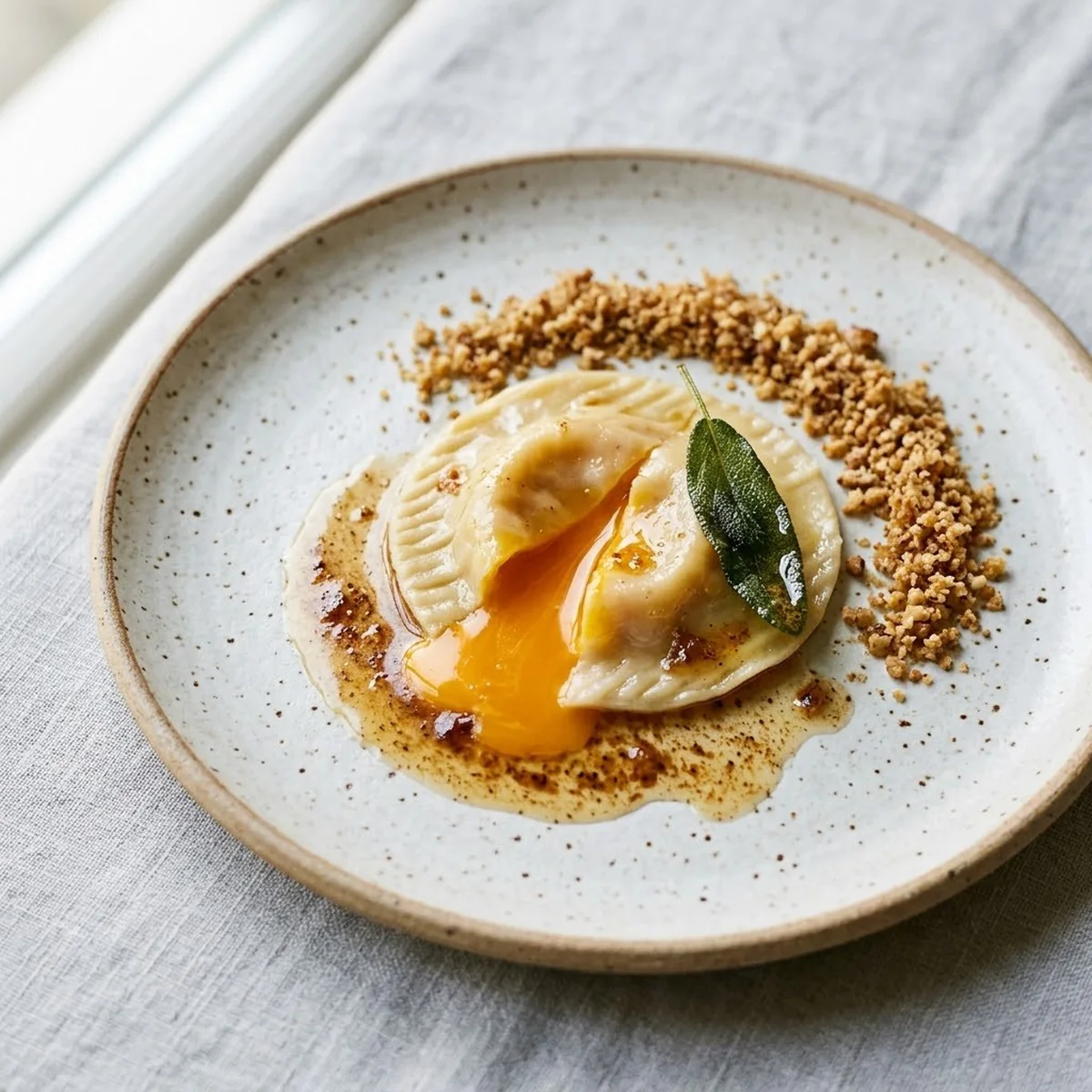
Warm the plates. Each plate receives one raviolo, placed in the centre — this is the one occasion in this cookbook where centred plating is correct. The raviolo is the whole dish. Ladle beurre noisette and walnuts around the raviolo and over it — not concealing the pasta dome, but framing it. Grind black pepper generously over the top. Grate Parmigiano if using (the chef's version only). Flaky salt. Do not add any garnish. The raviolo should look like what it is: one thing, perfectly executed.
Carry the plates to the table. Give each person a knife and fork. Say: "Cut through the centre."
08 · The moment
This is a Rupture. The knife goes through the pasta at the table, not in the kitchen. Hold the fork still for two seconds after cutting — let the yolk find its own level. It will run into the beurre noisette and the two will begin to emulsify on contact with the heat of the plate. The sauce assembles itself. You did not make this sauce. You made the conditions for it to happen. Say nothing. Hold still. Two seconds.
09 · Chef's notes
If something goes wrong
The yolk broke during construction: start again. There is no salvaging a broken yolk inside a raviolo — it will cook through completely and the moment will not exist. The pasta sealed with a visible air pocket: press it out gently with your thumb, working the air toward the unsealed edge before closing. If the raviolo has already been sealed: make a very small incision with a knife tip at the edge, expel the air, and reseal with a drop of water and firm pressure. The pasta tore during cooking: it was rolled too thin, or there was an unsealed edge. Serve immediately anyway — a tear shows the yolk; it is theatre of a different kind, not a catastrophe. The yolk is set and not flowing: the water was at a full boil rather than a simmer, or the raviolo cooked too long. The dish is still good to eat — it has become a warm egg pasta. Not the dish you planned, but not nothing.
Substitutions
Ricotta (if you have it): use instead of béchamel dam. Place 1 tbsp ricotta on the pasta, press a hollow in the centre with the back of a spoon, place the yolk in the hollow. Seal as above. The ricotta gives a lighter, cleaner flavour around the yolk — it is the more elegant solution. The béchamel version was invented here out of necessity and turns out to be architecturally correct even when ricotta is available. Walnuts → hazelnuts (better mirror of beurre noisette aromatics — highly recommended if available). 00 flour → plain flour: pasta will have slightly more bite and be slightly harder to roll thin; increase resting time to 45 minutes.
Scaling
Do not make more than 4 ravioli at one time. This recipe does not scale gracefully — the construction is painstaking and the cooking window is narrow. For a dinner party: make two and eat them together, or serve as a shared starter with each person receiving half a raviolo. That said, the construction gets faster after the second attempt.
Vegetarian / Omnivore variant
This dish is vegetarian. For the wife-inclusive version: omit Parmigiano. Replace with a few drops of good aged balsamic to add acid depth, or a spoonful of white miso dissolved into the beurre noisette for umami. The yolk provides all the richness required. For the chef's version: finish with chili oil instead of (or alongside) chili flakes, and add Parmigiano freely.
10 · Drink pairing
A serious white Burgundy
Meursault or Puligny-Montrachet. The butter in both the beurre noisette and the wine share the same lactic richness; the mineral backbone of white Burgundy cuts through the fat without competing with the yolk. If that's outside budget: a Mâcon-Villages or a good white Rhône (Grenache Blanc, Roussanne). Avoid tannic reds — they fight the egg. Avoid Sauvignon Blanc — too sharp, too grassy.
Warm lemon water (not cold
cold water fights the butter; warm water with a squeeze of lemon is more aligned with what's happening on the plate). Or a light chamomile tea — the honey-and-hay notes in good chamomile are surprisingly coherent with beurre noisette.