Cold Seam
Brown butter, buried caramel, malt, black fudge
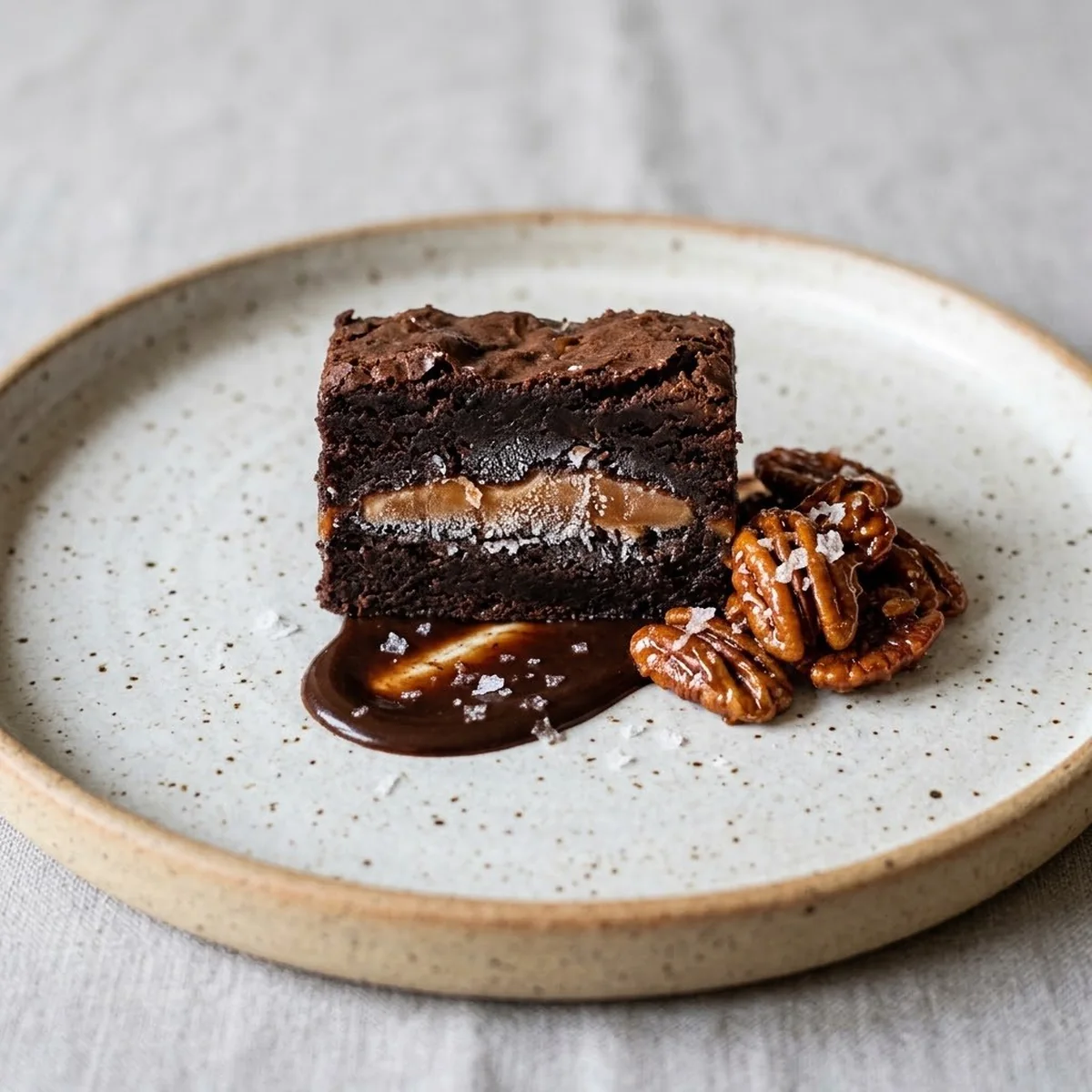
The knife breaks the crackle top with a sound like thin ice, travels down through a dark tender crumb, and then stops — because the last centimetre is not cake. It is cold fudge, and it holds the blade.
01 · Flavor architecture
02 · Time breakdown
Stage detail
| Stage | Clock time | Active? | Note |
|---|---|---|---|
| Cook the caramel + freeze the slab | 20 min | Yes | Then freeze 60 min — start here, everything else runs inside this window |
| Caramelize the pecans (two-stage) | 15 min | Yes | Full attention at the second stage; the window between sandy and burnt is short |
| Beurre noisette + melt chocolate | 10 min | Yes | Butter must cool to 45°C before it meets the eggs |
| Ribbon the eggs and sugars | 6 min | Yes | Machine does the work; prepare the tin and weigh the dry mix while it runs |
| Fold and build the tin in strata | 9 min | Yes | Do not fold past the point where the streaks disappear |
| Bake | 32 min | No | Stay in the kitchen for the last 8 minutes. Clear a fridge shelf |
| Cool at room temperature | 60 min | No | Non-negotiable. Do not move it to the fridge hot |
| Chill | 3 h | No | This is where the fudge base is actually made |
| Cut + two-temperature finish | 8 min | Yes | Hot dry knife; grill blast |
| Total active | 55 min | Inside the Gastronomy Under One Hour constraint | |
| Total clock | 5 h 30 min | Weekend session |
03 · Ingredients
- caster sugar115 g
- glucose syrup (or golden syrup) — not optional, see Why It Works25 g
- water30 g
- double cream, 35%, hot90 g
- unsalted butter, cold, cubed32 g
- fleur de sel3 g
Yields about 230 g. 180 g becomes the frozen slab; 50 g is held back soft for the marbling.
- pecan halves130 g
- caster sugar65 g
- water25 g
- drops neutral oil3
- fleur de sel1 g
- unsalted butter (yields roughly 200 g beurre noisette)240 g
- dark chocolate, 70%, chopped fine — this melts150 g
- dark chocolate, 70%, cut by hand into 2 cm chunks — this stays whole150 g
- large eggs (165 g) plus 1 extra yolk (18 g), at room temperature3
- caster sugar165 g
- dark muscovado sugar90 g
- plain flour95 g
- ground almonds25 g
- Dutch-process cocoa30 g
- non-diastatic malt extract powder, or malted milk powder20 g
- fine sea salt6 g
- baking powder2 g
- reserved caramel, soft50 g
- Fleur de sel
Equipment: 20 × 20 cm square tin, plus a second slightly larger tin or two stacked baking trays. Kitchen machine with a whisk. A probe thermometer — for both the caramel and the bake it is the only honest measure.
On the malt: non-diastatic malt extract powder is the better choice — more malt character, less sugar and milk solid. Malted milk powder is easier to find and tastes of Ovomaltine to a child, which is a feature here. Never use diastatic malt; its active enzymes attack what little starch this batter has and leave you with a gummy crumb.
This has been made once entirely from what a standard Dutch supermarket (Albert Heijn) stocks. It works, but three of the four swaps move the flavour, so they are recorded here with their consequence and their correction.
The supermarket version
| In the recipe | Supermarket | Consequence | Correction |
| 25 g glucose syrup | 25 g Van Gilse schenkstroop (Dutch dark pouring syrup) | Does the same structural job — it is an invert sugar syrup, so it obstructs the sucrose crystals just as well and the seam stays chewy out of the fridge. Flavour does shift: schenkstroop carries its own dark, almost liquorice-adjacent sweetness, so the seam reads less clean. | See below — it cancels against the basterdsuiker |
| 90 g dark muscovado | 90 g dark basterdsuiker (moist Dutch brown sugar) | Basterdsuiker is moist and contains invert sugar, but carries far less molasses. You lose the smoky-mineral tail under the cocoa; the crumb reads rounder and sweeter. | Fine sea salt to 7 g |
| 20 g malt extract powder | 20 g Ovomaltine | Already permitted in the base recipe. Roughly half its weight is sugar plus milk powder and cocoa, so you get less malt per gram and more chocolate-malt drink. For the children that is a gain. | Caster sugar in the batter to 155 g — this holds the sugar-to-egg ratio at 1.4:1 and so keeps the crackle |
| Fleur de sel | Maldon sea salt flakes | In the caramel and on the pecans it dissolves identically. On top it is better: larger, drier flakes give discrete salt hits rather than an even seasoning, and this dish's finish is a salt tail. | None — keep the gram weights |
On caramel colour with these swaps: schenkstroop pushes the dark register up, basterdsuiker pulls it down. They very nearly cancel. So cook the caramel exactly as written — one shade past your nerve — and no darker, or it turns sharp instead of bitter.
Shopping arithmetic: 300 g butter covers 240 g batter + 32 g caramel. 4 eggs covers 3 whole plus the loose yolk; the leftover white keeps three days. 150 g pecans leaves 20 g of margin for breakage and tasting. Buy the chocolate in bars, not chips — chips carry stabilizers that hold their shape, which gives hard points in the crumb instead of soft-set chunks.
04 · Technique
Cook the caramel dark, because it is carrying the contrast on its own
Combine 115 g caster sugar, 25 g glucose syrup and 30 g water in a heavy pan. Stir once to wet the sugar, then stop stirring — from here you swirl the pan, you do not stir it. Boil until the syrup turns pale amber, then deep amber, then a dark reddish-amber that smells faintly bitter. Go one shade past where your nerve tells you to stop. This colour is the entire bitter counterweight in the finished dish.
Off the heat, pour in 90 g hot double cream (35%) in three additions. It erupts violently the first time — stand back and let it settle between additions. Return to medium heat and cook to 119°C, stirring gently. Off the heat, whisk in 32 g cold butter cube by cube and then 3 g fleur de sel. Blend smooth with a stick blender if it looks at all split.
Reserve 50 g in a small bowl for the marbling. Pour the rest (about 180 g) onto parchment inside an 18 × 18 cm frame — or simply spread it to that footprint at about 4 mm — and cool, then freeze flat for at least 60 minutes.
Once frozen, snap the slab into four or five large shards. Not a single sheet. This matters structurally and it is explained in Why It Works.
Caramelize the pecans twice
Bring 25 g water and 65 g caster sugar to a boil in a wide pan and let it boil for one minute. Add 130 g pecan halves. Stir with a spatula, steadily, over medium heat. The syrup thickens, goes cloudy, and then crystallizes into dry sand around the nuts — this is sablage, and it looks like a failure. It is not.
Raise the heat slightly and keep stirring. The sand melts back down, darkens, and coats the pecans in a golden caramel. The moment the smell turns from sugar to toffee, take the pan off the heat. Add 3 drops of neutral oil, stir once to loosen, and tip the nuts onto parchment, pushing them apart so they cool as individuals. Scatter 1 g fleur de sel over while they are still tacky.
Cool completely. Chop 90 g roughly — that goes into the batter. Keep 40 g in halves for the top.
Brown the butter, then build the fat
Melt 240 g unsalted butter in a light-coloured pan over medium heat. It foams, quietens, and then the milk solids at the base turn amber and the smell goes distinctly nutty. Pull it there. Scrape every brown speck into a bowl — the solids are the flavour, not the fat.
Add 150 g finely chopped dark chocolate (70%) to the hot butter and stir until smooth and glossy. Set aside and let it fall to 45°C. Hot fat scrambles a whipped egg foam.
Ribbon the eggs, because this is where the crackle top gets made
Whisk 3 large eggs (165 g), 1 extra yolk (18 g), 165 g caster sugar and 90 g dark muscovado on high speed for 5 to 6 minutes. You want a pale, thick, mousse-like mass that falls off the whisk in a ribbon and holds its trail on the surface for three seconds. The sugar must be fully dissolved — rub a little between your fingers; if it is gritty, keep going.
Fold, and stop early
Sift 95 g plain flour, 30 g Dutch-process cocoa, 20 g malt powder, 6 g fine sea salt and 2 g baking powder together, then stir in 25 g ground almonds. Pour the 45°C chocolate mixture into the ribboned eggs and fold with a spatula — large, slow strokes from the base of the bowl. Add the dry mix and fold until the last streak of flour disappears and not one stroke further. Fold in the 150 g of 2 cm chocolate chunks and the 90 g chopped pecans.
Build the tin in strata, and insulate the base
Line the 20 × 20 cm tin with parchment, corners in, two long tails hanging over for lifting. Spoon in one third of the batter and level it. Lay the frozen caramel shards (about 180 g, four or five pieces) across it, leaving a finger's gap between each shard and a 1.5 cm margin at every wall — caramel that reaches the sides will run down and weld. Cover with the remaining batter and level it gently.
Warm the reserved 50 g caramel until just pourable. Dot it over the surface in six places and drag a skewer through in loose S-curves, taking the marbling right out to the edges. Press the reserved 40 g pecan halves in. Fleur de sel across the whole surface.
Now nest the tin inside a second, slightly larger tin, or set it on two stacked baking trays. The air gap under the base is the whole point.
Bake hot and short, and pull it looking wrong
Oven at 190°C conventional — no fan — with the rack in the upper third. Bake 30 to 35 minutes.
You are done when the outer 3 cm has domed and gone matte with a fine crackled skin, and the middle third still shivers when you knock the tin. Probe the centre at mid-height, avoiding a caramel shard: 84°C. At 90°C you have made a chocolate cake. There is no way back from that.
Cool, chill, then split the temperature
One hour at room temperature in the tin. Then a minimum of three hours in the fridge, uncovered. Lift out by the parchment tails.
Cut cold, with a long knife run under hot water and wiped dry between every cut. The caramel seam is chewy at fridge temperature and will drag on a cold blade. Four by four, 5 cm squares.
For service: lay the squares on a tray and give them 40 seconds directly under the grill of the steam oven — close, high, watched. The top goes warm and the crackle sharpens. The base stays fridge-cold and stays fudge. Plate within a minute; the gradient closes fast, and the gradient is the dish.
05 · Why it works
7 principles
The flour is deliberately starved. At 95 g against roughly 1.4 kg of total batter, flour is under 7% of the mass — where a cake sits at 25–30%.
Almost no starch gelatinizes and almost no gluten forms, so the block is not held up by a flour network at all. It is held up by set egg protein and by solidified cocoa butter and butterfat. That is the mechanism behind the fudge base: the texture you want is set fat, not set starch, which is why the three hours in the fridge are structural and not a resting convenience. Bite it at room temperature and the fat is soft; bite it cold and it is fudge.
The crackle top is meringue, and it is why the sugar did not come down further. Whipping the eggs and sugar to a full ribbon dissolves the sugar into the egg water.
In the oven that sugar-saturated foam floats to the surface, the water flashes off, and it dries into a paper-thin meringue film. The film needs a sugar-to-egg ratio of roughly 1.4:1 to form reliably; the reference formulas sit at 1.75–1.8:1. Cutting another 50 g of caster to compensate for losing the tahini would have dropped this to 1.15:1 and taken the crackle with it — so the sweetness correction is taken from salt at 6 g, cocoa at 30 g, and a caramel cooked genuinely dark instead.
The fat is now entirely water-free, and that is deliberate. Tahini was doing a physical job as much as a flavour one: about 55% fat and effectively no water, against butter's 16% water.
Replacing it with plain butter would have pushed water back into the batter — more steam, more lift, a cakier crumb, less fudge. Beurre noisette solves it, because browning butter is the process of driving its water off. Going from 200 g to 240 g of raw butter yields the fat that tahini was contributing, with none of the water. The 25 g of ground almonds replaces the sesame solids and keeps the crumb short — Ferrandi uses almond flour in their brownie for exactly this.
The glucose syrup is structural, not a professional affectation. A pure sucrose caramel recrystallizes as it cools and again as it chills, and a recrystallized seam inside a cold brownie is a sheet of hard candy you cannot cut through.
Glucose is a different sugar with a different molecular shape; it physically obstructs sucrose crystals from lining up. That, plus the cream and butter, is what keeps the seam plastic and chewy straight out of the fridge. Leave the glucose out and the dish fails at the knife.
The insulated base is the fudge lever. A metal tin base in a 190°C oven conducts heat faster than anything else touching the batter — it is the first surface to drive the base past coagulation.
Nesting the tin creates a still air gap, so while the centre reaches 84°C the bottom centimetre lands nearer 75°C: egg protein just barely set, starch untouched, fat waiting to be chilled. The base is engineered, not hoped for.
The seam goes in frozen, and in shards. Migoya's entremet method in The Elements of Dessert places frozen inclusions into a construction so that the inclusion lags the bake and keeps its own identity.
Applied here, a frozen caramel slab arrives at the oven some 60°C behind the batter around it, so it softens into a continuous seam rather than dissolving into the crumb. Cooking it to 119°C rather than sauce consistency matters for the same reason — a soft sauce caramel would liquefy at oven temperature and run. Shards rather than one sheet, because a continuous sugar-and-fat plane through the middle of the block is a shear plane: the brownie would split along it the moment you lifted it. The gaps let batter bridge top to bottom and hold the block together.
Malt does what the coffee used to do. The espresso was never a flavour — at under 0.5% of batter weight it sits below the threshold where it registers, and its job was to suppress perceived sweetness and deepen the cocoa.
Malt is caffeine-free and sits in the same Maillard family (§6.6): the roasted barley carries the pyrazines and furanones that bridge to chocolate, brown butter and caramel. Migoya pairs the two directly in the Chocolate and Malt Pops in the same book. It reads to an adult as depth and to a child as a familiar chocolate-malt drink.
06 · Texture map
07 · Plating
This is a tray bake and it should look like one — but cut and stacked, not laid out in rows.
Set two squares per plate, one flat, the second leaning against it at an angle so the cross-section faces the eater. The strata are the plating: black crackle line at the top, dark crumb, a bright gold caramel line running through at one third height, and the near-black glossy base. Nothing goes on top and nothing goes around. A brownie under a dusting of icing sugar is a brownie hiding its section.
Negative space on the right two thirds of the plate. If you want a partner, a quenelle of crème fraîche goes at the far edge, not touching — its acidity is a palate reset between squares, and it belongs at arm's length so the eater chooses when to use it. For the children, skip the plating entirely and hand them a square on a napkin; the cross-section still does the work.
08 · The moment
This is a Reveal, and it has a Sound underneath it. Do not pre-cut the whole block in the kitchen. Bring the chilled slab to the table on its parchment with the long knife, and make the first cut in front of whoever is eating. The crackle top gives first with a dry snap. The blade then travels through the crumb without resistance and stops twice — once at the caramel, once in the last centimetre — and you have to lean on it. Those two pauses are the reveal; everyone at the table hears the knife stop. Lift the first square out and turn it so the cut face is toward them before you set it down. Say nothing about the gold line. Let them find it.
09 · Chef's notes
If something goes wrong
The caramel crystallized into a grainy, opaque mass while cooking. A sugar crystal got in, usually off the side of the pan or off a stirring spoon. There is no fix in the pan — start again, swirl instead of stirring, and brush the pan walls down with a wet pastry brush.
The caramel seized when the cream went in. The cream was cold. Return the pan to low heat and stir until it comes back together; if it stays lumpy, blend it with a stick blender.
The caramel slab is rock-hard out of the freezer and shatters into dust. That is correct — it should snap into shards. If it powders completely rather than breaking into pieces, it was spread too thin. Use the pieces anyway; the seam will be broken rather than continuous, which costs appearance but not much texture.
Probe read 90°C or higher — no fudge base. You have made a good chocolate cake and there is no route back. Salvage it honestly: cut into 3 cm cubes, dry them at 140°C for 10 minutes into brownie croutons, and serve them over ice cream. Next time pull 4 minutes earlier and trust the wobble.
The chocolate-butter mixture seized into a dull grainy paste. Water got in. Whisk in 20 g of extra warm butter — never water, which makes it worse.
No crackle top. The sugar was not dissolved when the eggs went in. Nothing to fix on this tray; on the next one, ribbon for a full 6 minutes and do the finger test.
Caramel ran down the sides and welded the block to the parchment. The shards were laid too close to the walls. Freeze the block hard, then peel the parchment away in strips rather than trying to lift the slab out in one movement.
The middle is genuinely raw batter, not fudge. The frozen shards were thicker than 4 mm and pulled too much heat out of the centre. Return it to a 170°C oven for 6 minutes, then cool and chill as written.
Substitutions
Pecan → walnut. You lose pecan's buttery sweetness, which after the tahini came out is the only soft-sweet note against dark caramel and cocoa. Walnut's tannin stacks onto the bitter side of an already bitter dish. If you make the swap, take the pecan caramel a shade lighter and add 15 g more muscovado.
Pecan → omit entirely (if a child at the table has a nut allergy). You lose the hard-crack texture and drop from six textures to five, which is still inside §11. Replace with 90 g of cacao nibs folded through: same shattering crunch, but they add bitterness rather than relieving it — so take the batter caramel one shade lighter and drop the fine sea salt to 5 g.
Glucose syrup → golden syrup. Works, and it is easier to buy. Golden syrup carries its own caramel flavour, so the seam reads sweeter and less clean; take the caramel itself one shade darker to compensate.
Glucose syrup → omit. Do not. See Why It Works — the seam sets hard in the fridge and the dish fails at the knife.
70% → milk chocolate chunks. The sugar rises and the dark caramel has nothing to push against; the whole thing goes flat. If you must, drop the caster sugar by 40 g and take the fine sea salt to 7 g.
Dutch-process cocoa → natural cocoa. Natural cocoa is acidic and lighter. With 2 g baking powder present you get more lift than you want; you lose the near-black colour and gain a sharper, fruitier note that sits oddly against burnt sugar.
Malt powder → omit. The chocolate reads sweeter and shallower. It is not a flavour you will consciously miss — you will simply find the brownie less deep and not know why.
Scaling
To a 20 × 30 tin: multiply by 1.5, bake 5 minutes less, and the base insulation stops being optional — a thinner slab drives to full set from below before the top has crackled. Do not scale to a half sheet pan. At that depth the frozen shards thaw before the surrounding batter sets, the seam dissolves into the crumb, and the dish's central idea is gone.
Two 20 × 20 tins is the better way to make more: double everything, keep the depth, keep the fudge base. Bake them side by side only if your oven is genuinely wide enough for air to move between them; otherwise bake in two rounds and hold the second batch of batter at room temperature, not in the fridge.
Vegetarian / Omnivore variant
Vegetarian by construction, and wife-safe — no cheese anywhere. Caffeine-free, so it is child-safe at any hour; the only stimulant left is the small amount of theobromine naturally in the chocolate, which is unavoidable in a brownie.
There is no meaningful omnivore delta for a brownie, so the delta that matters is the chef-only one: swirl 20 g chili crisp into the reserved caramel on half the tray only, marbled up to a line you can see, and mark that half with a row of pecans laid in a stripe so nobody takes the wrong square. Capsaicin is fat-soluble and bridges straight into the cocoa butter, and the heat arrives after the salt rather than with it. One batter, two finishes, and the children's half is untouched.
10 · Drink pairing
Banyuls or Maury
Grenache-based vin doux naturel, served at 14°C. The logic in `_databases/drinks-wine-pairing.md` §1.5 applies directly: a fully dry wine tastes austere against this much sugar, but the dish's real register is Maillard rather than sweet, so what you want is a wine with its own oxidative, caramel-adjacent character to mirror the brown butter, the malt and the dark caramel. This pairing got better when the sesame came out — Pedro Ximénez was previously the riskier call because it overpowered tahini, and with tahini gone it is now a fair second choice.
Hojicha, hot
`_databases/drinks-wine-pairing.md` §4 names it "the non-alcoholic Maillard beverage" — roasting the tea leaf creates Maillard products, so it mirrors the brown butter, the malt and the caramelized pecan directly. Roasting also strips the catechin bitterness, so it does not stack another bitter layer onto cocoa and burnt sugar. Note for this table: hojicha is low in caffeine but not free of it.
cold whole milk, and this is not a concession
Casein binds the astringent polyphenols in cocoa and pulls them off the palate, which is why the chocolate reads rounder and less drying alongside milk. It is the same mechanism that makes milk chocolate taste softer than dark, applied at the glass instead of in the bar.
11 · Sources and Composition
Per §17 — every decision has a source, the combination is original.
| Decision | Source |
| Bakers' percentage skeleton: fat ~17% / chocolate ~14% / flour ~11%, ribbon-stage eggs, chill before cutting | Migoya, The Elements of Dessert (CIA), Brownie, p. 430 |
| Malt as a chocolate deepener | Migoya, The Elements of Dessert, Chocolate and Malt Pops, p. 500 |
| Frozen inclusion placed into a construction so it lags the bake | Migoya, The Elements of Dessert, entremet assembly method, p. 396 |
| Split chocolate — part melted into the fat, part folded in as chunks; two-stage sablage caramelized pecans; almond flour in the crumb; soft caramel of glucose + cream + butter + fleur de sel, stick-blended | Ferrandi Paris, Fruits and Nuts, Caramel Pecan Brownies, p. 272 |
| Hot oven, short bake, pull on the wobble; "they may seem undercooked at first, they firm up as they cool" | Ottolenghi & Goh, Sweet, brownie method |
| Beurre noisette used structurally as the primary fat, not as a finishing drizzle | `_databases/techniques.md` §1 |
| Pecan + dark chocolate + caramel + salt; sea salt as structure at 0.2–0.4%; the Maillard Cluster principle | `_databases/flavor-pairs-condiments-proteins-fruits.md` lines 708, 997, 1014 |
| Hojicha as the Maillard non-alcoholic pairing | `_databases/drinks-wine-pairing.md` §4 |
the chef's own composition decisions (inferred, not sourced): 1. Migoya's frozen-inclusion method applied inside a brownie, and the caramel cooked to 119°C rather than sauce consistency so it survives the oven as a seam. Nobody in the library does this in a tray bake. Breaking the slab into shards to defeat the shear plane it would otherwise create is part of the same decision. 2. The insulated base tin. A deliberate thermal-gradient decision taken to serve a texture target, rather than a baking convention followed. 3. Loading the contrast entirely onto the caramel's colour. With coffee and sesame both removed for the children, the only bitterness left had to come from how far the sugar is taken. That is a flavour decision made in the pan, not on the ingredient list. 4. The two-temperature service. the chef's signature architecture (see `ch03-two-temperature-orchard.md`, `ch01-seduction-by-apple-scallop.md`) applied to a bake: warm crackle top against a cold fudge base, in one bite.