Scallops with Brown Butter and Apple Ceviche
Ice-cold acid fruit shatters against searing butter
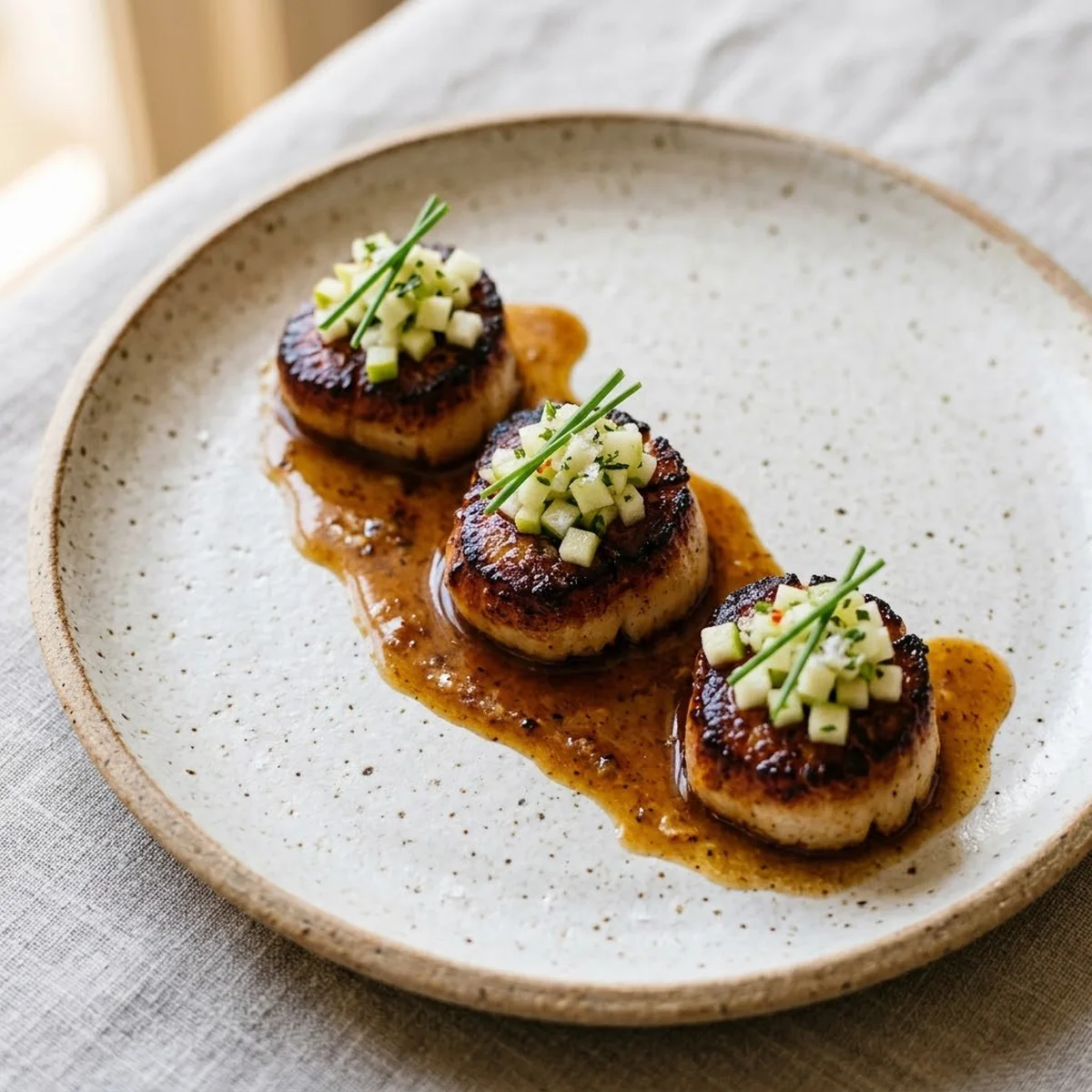
Part of the "Seduction by Apple" three-course menu (Ch 1). Serve this course, then move immediately to the duck breast preparation — the window between courses is your active cooking time for Course 2. The collision happens at the plate. Ice-cold apple hits a scallop that is still so hot the butter is barely still liquid. You have 90 seconds before the apple warms and the moment is gone.
01 · Flavor architecture
02 · Time breakdown
Stage detail
| Stage | Clock time | Active? | Note |
|---|---|---|---|
| Prepare apple ceviche | 10 min | Yes | Make this first — it needs to chill |
| Chill apple (in fridge) | 15 min | No | Use this time for Course 2 mise en place |
| Sear scallops + build beurre noisette | 5 min | Yes | Total focus required — do not multitask |
| Plate and serve | 2 min | Yes | Serve immediately or the moment is lost |
| Total active | 17 min | ||
| Total clock | 25 min |
03 · Ingredients
- ½ sharp apple — Granny Smith is the acid choice, Braeburn for flavor (brunoise: 2–3mm cubes, precise)
- ½ small red chili, seeds out, finely minced
- fresh lime juice (not bottled — the volatile aromatics matter here)1 tbsp
- good olive oil1 tsp
- fresh chives, finely sliced (not chopped — sliced for clean green edge)1 tbsp
- Flaky salt
- large fresh scallops (diver-caught if you can get them; wet-packed scallops hold too much water to sear correctly)4
- neutral oil (sunflower or grapeseed — butter alone will burn before the crust forms)1 tbsp
- unsalted butter50g
- Flaky salt and black pepper
04 · Technique
Build the apple ceviche (do this first)
Brunoise the apple: peel, quarter, core, and cut into cubes no larger than 3mm. If they are larger, the cold element won't integrate with the scallop — it will slide off. Mix with lime juice, minced chili, olive oil, and chives. Taste: it should be sharp and cold-tasting even at room temperature. Season with a pinch of flaky salt. Cover and refrigerate. It needs at minimum 10 minutes in the fridge to be genuinely cold — 15 is better.
Prepare the scallops
Pat scallops dry with paper towels. Dry again. If there is any moisture on the surface, you will steam rather than sear and the crust will not form. Season just before cooking — salt draws moisture. Season at the very last moment.
The sear
Get a heavy pan (cast iron or stainless, not non-stick) ripping hot over high heat until it begins to smoke. Add the neutral oil — it will shimmer immediately. Season the scallops on the flat sides only. Lay them in the pan away from you, flat side down. Do not touch them. 1 minute exactly. When you try to lift one and it releases cleanly, the crust has formed. If it sticks, give it 15 more seconds. Flip. 45 seconds on the second side. The centre should feel like a just-set gel when pressed — not firm, not raw-loose. Remove to a warm plate.
Build beurre noisette in the same pan
Immediately add the butter to the still-hot pan. It will go through its stages fast — the pan is already at temperature. Watch it: foam, then the foam subsides, then amber colour and hazelnut smell. This takes 60–90 seconds in a hot pan. Pull when it smells of roasted nuts and the milk solids are deep gold. The residual heat will keep it moving for another 15–20 seconds off the flame.
05 · Why it works
The thermal collision is the architecture of this dish: the apple brunoise is held close to 4°C; the scallop surface is close to 170°C when plated. At the moment the apple touches the scallop, you get two simultaneous reactions — the acid in the lime begins a very light cure on the surface of the scallop, and the heat from the scallop partially warms and opens the volatile aromatics in the apple. This lasts approximately 90 seconds before the apple reaches equilibrium temperature and the moment is gone. The chili in the ceviche reads differently cold versus warm: cold chili is sharp and direct; as it warms, it softens and spreads. The guest tastes it twice — once at the first bite, again at the finish.
06 · Texture map
07 · Plating
Warm the plates if possible — the scallop surface temperature drops fast. Place two scallops side by side, slightly off-centre left. They should not touch. Spoon the apple ceviche directly onto the top of the scallops — not beside them, not around them. On top. You want the visual of cold green-flecked apple sitting on the dark crust. Ladle beurre noisette from the pan over the scallops and the apple: one generous pass, enough that it pools slightly at the base of the scallops but does not flood the plate. Grind black pepper from height. The right half of the plate stays empty. Serve immediately — do not hold, do not cover, do not plate in advance.
08 · The moment
This is a Collision. The moment the apple ceviche meets the hot scallop, the dish begins to change. You have 90 seconds from plating to the table. Brief the person serving: plates go down, guest eats immediately. Do not wait for the other course to be plated. Do not take a photograph. The window is real and it closes.
09 · Chef's notes
If something goes wrong
Scallops stuck to the pan: the pan wasn't hot enough, or there was moisture on the scallop surface. For this batch: wait the extra 15 seconds, they will release. For next time: dry more thoroughly and heat the pan longer before the oil goes in. Beurre noisette gone too dark: wipe the pan and start again with 25g butter. You cannot rescue it. Ceviche too sharp: add ½ tsp more olive oil and a tiny pinch of sugar to round it, but do not lose the acid — that's structural.
Substitutions
Scallops → king oyster mushrooms scored and seared hard in the same fat (earthiness replaces sea sweetness; the thermal collision still works; increase chili by a third to compensate for the loss of the ocean-salt note). This is the wife-inclusive version. Granny Smith apple → ripe firm pear (less acid, more floral — you lose the sharpness that makes the collision pop; add a few more drops of lime). Lime → lemon (rounder, less volatile, less interesting; use lime if you can).
Scaling
For 4 people, do the scallops in two batches. Do not crowd the pan — four large scallops will drop the pan temperature and you'll steam rather than sear. Two batches of two, pan back to temperature between batches. The apple ceviche scales directly.
Vegetarian / Omnivore variant
Omnivore is the default here. For wife-inclusive: king oyster mushrooms, scored on the flat face in a crosshatch, pressed flat side down in the same hot fat. The technique is identical. The theatrical collision remains. Omit Parmigiano from any garnish.
10 · Drink pairing
Blanc de Blancs Champagne or a high-acid Chablis Premier Cru
the apple in the ceviche creates a mirror with the green apple notes in the wine, and the acidity cuts through the beurre noisette. Avoid anything with oak or residual sugar — both fight the lime.
Sparkling water with cucumber and a squeeze of lime, very cold
Or a pressed apple juice cut with sparkling water 50/50, unsweetened — the apple in the glass echoes the apple on the plate.