Duck Breast with Sticky Apple-Balsamic Jus and Celeriac Mousseline
Rendered fat, caramel fruit, silken root — one slow arc
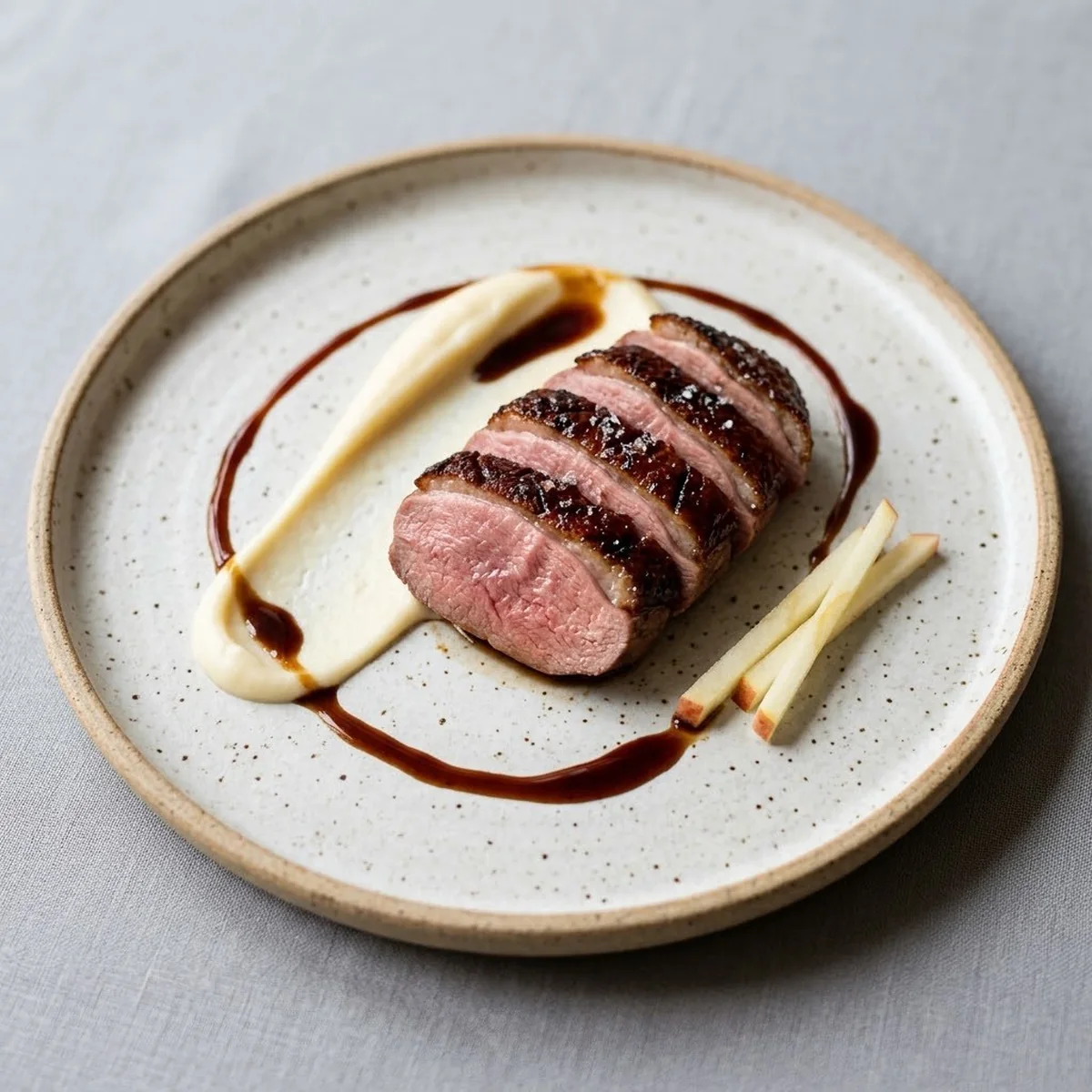
The sound of the jus hitting the hot sliced duck at the table is the beginning of the course. Seconds later, cold raw apple lands on the same slices — the duck is met twice, once hot, once cold.
01 · Flavor architecture
02 · Time breakdown
Stage detail
| Stage | Clock time | Active? | Note |
|---|---|---|---|
| Score duck skin, season | 3 min | Yes | Do this before Course 1 hits the pan |
| Render duck skin-side down | 18–20 min | No | Pour glasses, plate Course 1 during this time |
| Flip and finish duck | 3 min | Yes | |
| Rest duck | 8 min | No | Make jus during resting time |
| Celeriac mousseline | 30 min total, 15 min active | Parallel | Start this before anything else; it holds well |
| Build apple-balsamic jus | 8 min | Yes | While duck rests |
| Slice and serve | 4 min | Yes | Cut the apple matchsticks first; they wait in lemon in the fridge |
| Total active | ~35 min | ||
| Total clock | 50 min |
03 · Ingredients
- duck breasts, skin on (Barbary or Gressingham — both work; avoid pre-scored supermarket duck where the scoring is decorative rather than structural)2
- ½ medium celeriac (about 300g after peeling), cut into 3cm chunks
- apple (any sweet variety), peeled, cored, in rough chunks — equal weight to celeriac1
- warm double cream or crème fraîche50ml
- unsalted butter20g
- Flaky salt, white pepper (not black — it changes the colour)
- apple, quartered, core removed, cut into thick wedges1
- good aged balsamic vinegar (real balsamic, not cheap imitation — this is the acid architecture of the dish)3 tbsp
- apple syrup or honey (or maple syrup)1 tbsp
- chicken stock or water100ml
- Residual duck fat from the pan
- ½ crisp apple (the third apple of the dish), skin on, cut into fine matchsticks at the last moment
- Squeeze of lemon juice
- Flaky salt, black pepper
04 · Technique
Mousseline (start this first, before anything else)
Bring a pot of generously salted water to the boil. Add celeriac and apple chunks together. Cook until both are completely soft — about 20 minutes. Drain well and return to the hot pot for 2 minutes to evaporate residual moisture. Pass through a fine sieve or blend until completely smooth. Add warm cream and butter. The ratio is roughly equal parts purée and cream enrichment — taste as you go. The mousseline should fall from the spoon slowly, not hold a peak. Season with salt and white pepper. Keep warm with a lid on the pot; it holds for 30 minutes without deteriorating.
Score and render the duck
Score the skin of each breast in a tight crosshatch — cuts 1cm apart, deep enough to reach the fat but not into the flesh. Season the flesh side only, now. Skin gets no pre-seasoning — moisture will prevent crisping. Place duck breasts skin-side down in a cold, dry pan. Cold pan, not hot. Turn the heat to medium. The fat renders slowly from cold, eliminating moisture before the skin begins to colour. Over 18–20 minutes the skin will go from white to pale gold to mahogany. Tilt the pan every few minutes to redistribute the fat. When the skin is uniformly dark and sounds hollow when tapped — not wet, not tacky — flip. Season the skin side now, as it comes out of the fat. 3 minutes on the flesh side for medium-rare: the breast should feel like the base of your thumb — firm at the edges, soft at the centre. Remove and rest on a rack, skin-side up, for 8 minutes. Do not cover — you worked for that skin.
Apple-balsamic jus (while the duck rests)
Pour most of the duck fat from the pan into a small jar (save it — it's gold for roasting potatoes). Leave a thin coating. Raise heat to high. Add apple wedges cut-side down. They will caramelise in the residual duck fat — 2 minutes until they take colour. Add balsamic vinegar. It will hiss and steam violently. Add apple syrup. Add stock or water. Reduce at a hard simmer until the liquid coats the back of a spoon and the apple wedges are soft and lacquered — about 5–6 minutes. The jus should move like thin honey, not water. Taste: it should be intense, slightly sweet, decidedly acidic. Adjust with a drop more balsamic or a pinch of salt. Do not strain. The apple pieces are part of the presentation.
Cold apple, then slice and plate
Cut the half apple into fine matchsticks — skin on, the skin is the colour. Toss with the lemon juice and a pinch of flaky salt. Into the fridge until the last moment. It must go onto the plate genuinely cold — that is the point, not a garnish. Slice each breast on the bias, 5–6 slices per breast. Fan them slightly on the plate with the skin side up. The pink interior should be visible on each slice.
05 · Why it works
Starting duck in a cold pan is counterintuitive but correct: the gradual temperature increase allows the fat to render before the Maillard reaction begins, so you crisp dry fat rather than wet. The celeriac-apple mousseline uses equal parts of each because celeriac alone is too pungent and earthy, while apple alone is too sweet and lacks body — together they produce a purée that is simultaneously rooty and light, with the apple acting as a natural sweetener that doesn't need cream to soften it. The balsamic jus works on duck because duck fat is rich enough to absorb the acid without becoming unbalanced — the tannic depth of real balsamic aged in oak mirrors the depth of the rendered duck fat. And the same apple appears three times in three states — cooked into the mousseline, caramelised in the jus, raw and cold on the finished plate — so one ingredient supplies base, contrast, and surprise. The cold raw version arrives last, on hot meat: the temperature shock resets the palate against the fat, and nobody reading "apple" on a menu sees it coming.
06 · Texture map
07 · Plating
Place a generous spoon of mousseline left of centre — use the back of the spoon to pull it in a slow arc toward the rim, creating a comma shape rather than a blob. Fan the sliced duck over the mousseline, skin-side up. Place two or three caramelised apple wedges against the duck, not under it — they should be visible. Bring the jus to the table in the pan or a small warm jug, and the cold apple matchsticks in a small bowl straight from the fridge. Pour at the table, over the duck and across the mousseline. One continuous motion, not a drizzle. The apple in the jus lands naturally; don't rearrange it. Then place a loose tangle of the cold matchsticks directly on the hot glazed slices — after the pour, never before, or the jus cooks them. The right quarter of the plate is empty.
08 · The moment
This is a Pour with a cold second beat. The jus does not go on in the kitchen. It goes on at the table, in front of the person eating. Hold the pan or jug at medium height — not from overhead, which looks theatrical for the wrong reasons. Pour in one confident pass from left to right across the sliced duck. The sound of it landing on the hot meat is the signal that the course has begun. Then, straight from the fridge, drop the cold apple tangle onto the hot glazed slices. Cold hits hot; both are apple. Say nothing.
09 · Chef's notes
Menu timing
Part of the "Seduction by Apple" three-course menu (Ch 1). Start this course while Course 1 is being eaten — the duck needs 18–20 minutes skin-side down, which is your window.
If something goes wrong
Skin is rubbery, not crisp: the moisture didn't fully render before the colour developed. Return the breast skin-side down to a dry hot pan for 2 minutes before slicing — it will not be perfect but it will recover partially. Jus too thick: add a splash of water and stir over low heat. Too thin: reduce another 2 minutes on high heat. Duck overcooked: it happens. The mousseline is forgiving and will carry the dish; compensate with more jus.
Substitutions
Celeriac → parsnip (sweeter, slightly more floral — less earthy; works well but loses the distinctive celeriac note). Real balsamic → red wine vinegar + a tsp of brown sugar (sharper, less complex; reduce more slowly and add the sugar gradually). Apple syrup → honey or maple syrup (both work; honey gives a floral note, maple gives a wood-smoke depth that is surprisingly good here).
Scaling
For 4 people: two pans are better than one crowded pan — duck breasts need space to render. The mousseline scales directly. The jus: use all the accumulated duck fat from both pans for maximum depth.
Vegetarian / Omnivore variant
This is inherently an omnivore course in the Seduction by Apple menu. The vegetarian analogue in the same menu format is king oyster mushrooms scored and seared hard in butter, glazed with the same apple-balsamic jus, served over the same mousseline. The mousseline is unchanged. The jus loses depth from the duck fat — compensate with a small amount of white miso dissolved into the stock before reducing.
10 · Drink pairing
Pinot Noir
Burgundy if the occasion warrants it, New Zealand Central Otago if you want something riper and darker. The earthy cherry notes of Pinot work with both the duck and the apple in the jus. Avoid tannic reds — they fight the balsamic. Avoid white wine here — the fat weight of the duck needs red.
Unsweetened cherry juice diluted with water (50/50) and a squ…
eze of lemon. The natural fruit acid and depth mirrors what the Pinot would have done.