Gnocchi d'Oro
Burnt butter, roasted squash, crisp sage, hazelnut heat
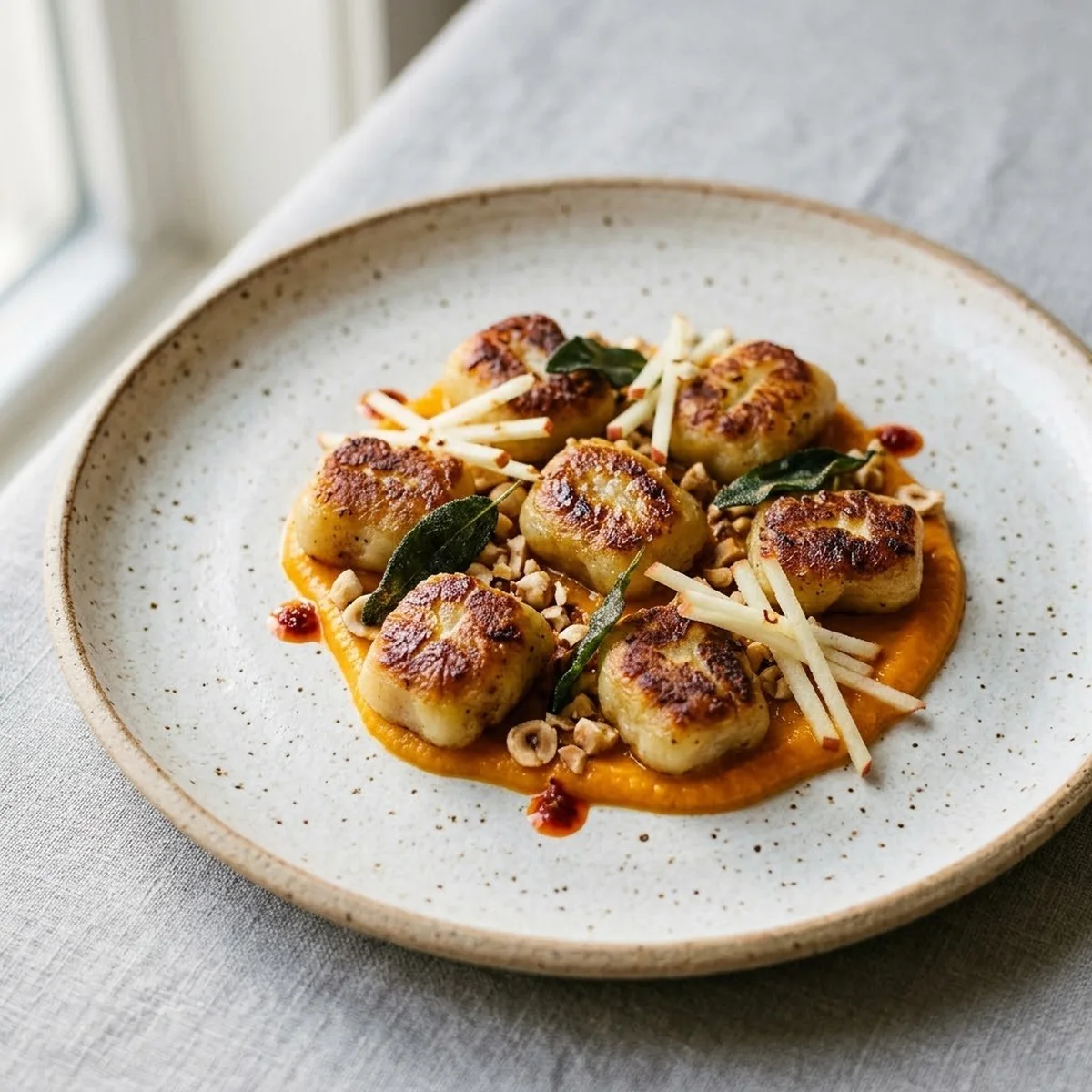
The gnocchi hit the beurre noisette and they hiss. That sound — not a splutter, not a sizzle, something sharper — is the crust forming. Everything else in this dish is built around that 90-second window.
01 · Flavor architecture
02 · Time breakdown
Stage detail
| Stage | Clock time | Active? | Note |
|---|---|---|---|
| Roast squash in oven | 20–25 min | No | Prep the rest of the dish during this time |
| Make hazelnut beurre noisette | 5 min | Yes | Use a light-coloured pan — colour is everything |
| Pan-fry gnocchi | 8–10 min | Yes | No boiling. Ever. |
| Assemble and finish | 3 min | Yes | Work quickly; gnocchi cool fast |
| Total active | 16–18 min | ||
| Total clock | ~40 min |
03 · Ingredients
- butternut squash (1cm cubes — no larger; you want caramelisation on every face)400g
- olive oil1 tbsp
- small garlic clove, crushed in its skin1
- Flaky salt and black pepper
- fresh or chilled gnocchi (not dried; the moisture content is different)400g
- unsalted butter50g
- generous handful fresh sage leaves (15–20 leaves)1
- hazelnuts, roughly chopped (some halves, some smaller — uneven is correct)30–40g
- small garlic clove, crushed1
- ½ small tart apple (Granny Smith or Cox — tart, never sweet), fridge-cold, cut into fine matchsticks at the last minute
- Generous pinch of dried chili flakes
- drops aged balsamic vinegar (or a few drops of good red wine vinegar — not balsamic glaze from a bottle)5–6
- Parmigiano Reggiano, finely grated (see vegetarian note)30–40g
- Flaky salt
04 · Technique
Roast the squash to caramelisation, not softness
Preheat oven to 200°C. Toss squash cubes with olive oil, salt, pepper, and the crushed garlic clove. Spread on a baking tray — single layer, no touching. If they overlap, they steam. You want dry heat on every surface. Roast 20–25 minutes until the edges are mahogany and the cube gives when pressed. Pull and set aside. The garlic will be soft inside its skin; squeeze it out and keep it.
Build the beurre noisette with the hazelnuts
Use a light-coloured stainless or ceramic pan. Dark pans hide the colour until it is already burnt. Set over medium heat. Add butter in one piece. It will melt, then foam — this is the water leaving. When the foam subsides and the butter goes quiet, the temperature has climbed past 150°C. Add the hazelnuts immediately. They toast in the butter as it continues to colour. Watch the pan, not the clock. The butter will darken through pale gold to amber. When it smells of roasted hazelnuts and the milk solids on the pan base are a dark gold, add the sage leaves. They will crackle and spit for 10 seconds and become completely rigid and translucent at the edges. Pull the pan from the heat. The sage is done when it rings if you tap it against the rim — not when a timer goes off.
Pan-fry the gnocchi directly in the residual fat
Return the pan to medium-high heat. Add the gnocchi straight from the packet — no boiling. They go into the fat in a single layer. Leave them alone for 2 minutes. Do not move them. A crust is forming. Use this window: take the apple straight from the fridge and cut it into fine matchsticks, skin on. It goes back in the fridge until the second the plate is finished — the apple must hit the dish cold. When the underside releases cleanly and is deep gold, turn. The second side needs only 90 seconds. Add the roasted squash and the squeezed garlic back to the pan. Add chili flakes. Toss everything together for 2 minutes so the fat coats every surface.
Finish and plate immediately
Off the heat, add the balsamic. Toss once. The acid cuts through the fat and lifts everything. Taste. Adjust salt. The apple never touches the pan — it is scattered over the plated dish, cold from the fridge, so it lands on the hot gnocchi at maximum temperature distance.
05 · Why it works
Pan-frying gnocchi without boiling first skips the water-logging step and sends the surface directly into the Maillard reaction — the same reaction that makes beurre noisette smell of hazelnuts. The result is a crust that holds structural contrast against the soft interior. Sage fried in beurre noisette becomes brittle rather than wilted because the water content evaporates almost instantaneously in fat at 160°C+. The hazelnut crunch mirrors the hazelnut aromatics of the butter itself — this is not decoration; it is reinforcement of the same flavor molecule. A drop of balsamic at the end is not sweetness — it is acid, and it is essential to stop the dish tasting of nothing but fat. The cold apple does the same job through a different channel: its malic acid cuts the butter, but the real move is temperature — a fridge-cold, wet-crisp element landing on a pan-hot dish amplifies both extremes, the same hot-seared-scallop-with-ice-cold-apple architecture applied to a pan of gnocchi. Apple against sage is not an accident either — apple's acid brightens sage's camphor edge.
06 · Texture map
07 · Plating
Do not use a bowl. A wide, flat plate with a low rim. Spoon the gnocchi off-centre, heaped rather than spread. The sage leaves go on top — not buried, not scattered randomly. Place three or four vertically, so they catch the light. The hazelnut crunch goes over the top third of the heap. Grate Parmigiano directly over the top — not from a pre-grated pile. Last, straight from the fridge: scatter the apple matchsticks loosely across the lower half of the heap, a few resting against the hot gnocchi, a few landing on the plate. They go on after everything else so they stay cold. Six drops of balsamic at the edge of the plate: 10, 2, 4, 8 o'clock positions — not pooled in the centre, not drizzled from height. The negative space on the right side of the plate stays empty. Do not fill it.
08 · The moment
This is a Sound. Before you carry the plate to the table, pick up one sage leaf and tap it lightly against the rim of the plate. If it rings — thin and sharp, like tapping a dried leaf — it is done correctly. If it flexes, it went in too early or came out too late. Make this moment visible at the table: pick the leaf up, tap it, put it back. Say nothing. The sound explains the dish.
09 · Chef's notes
If something goes wrong
Butter has gone too dark and smells acrid: pull the pan immediately, wipe it with paper, start the butter again. You cannot rescue burnt butter. The hazelnuts may be salvageable if they haven't crossed into bitter — taste them. If the gnocchi won't release from the pan, the fat wasn't hot enough when they went in or you moved them too early. Leave them another 30 seconds and try again with a palette knife. Do not force.
Substitutions
Sage → fresh rosemary (strip the leaves from the woody stem; they fry the same way but give a more resinous, piney note instead of the sage's camphor edge — increase the chili slightly to compensate). Hazelnuts → walnuts (more bitter and tannic; the mirror between hazelnut crunch and hazelnut butter is broken, but the dish still works — add a few drops more balsamic to balance). Balsamic → red wine vinegar (sharper, less sweet; you lose the depth but gain clarity — fine choice). Apple: only tart varieties (Granny Smith, Cox) — a sweet apple turns the finish into dessert and collapses the acid line; if there is no tart apple in the house, a few cold matchsticks of fennel bulb give the same cold snap with an anise note instead of the malic bite — increase the balsamic by two drops to keep the acid.
Scaling
For 4 people, double everything but use the same pan in batches — do not crowd the gnocchi. Crowded gnocchi steam rather than crisp. The butter quantity does not scale linearly: 75g is enough for 4 people.
Vegetarian / Omnivore variant
This dish is already vegetarian. For the wife-inclusive version: omit Parmigiano (it is strong-aged). Replace with a few flakes of good mild feta crumbled over at the end (salty, fresh, slightly tangy — it will not overpower), or simply leave off cheese entirely and increase the balsamic drops by two. The dish does not need cheese to be complete — the beurre noisette provides all the richness required. For the chef-only version: add 4–5 drops of chili oil from the bottle rather than flakes — the oil carries heat differently, coating rather than concentrating.
10 · Drink pairing
A Friulian Ribolla Gialla or skin-contact orange wine
the slight tannic bitterness and oxidative note cuts through the butter without fighting the hazelnut. Alternatively, a lighter Barolo Chinato if you want something with length. Avoid anything oaky or sweet.
Sparkling water with a slice of blood orange squeezed in
The acid does the work the wine would have done. Do not use still water — the flatness fights the richness of the dish.